Mercedes-Benz Aerodynamics – Artistry and Science in Motion
For more than a century, the pursuit of efficiency and speed has driven automotive design. At Mercedes-Benz of Scottsdale, we appreciate that the very shape of a vehicle is its most critical feature. The deep commitment of Mercedes-Benz to air-sculpted design translates directly into added value for you, our esteemed clientele, resulting in superior driving dynamics, increased range, and exceptional long-distance comfort. Read on to discover the story of Mercedes-Benz aerodynamics in action!
A Tradition of Aerodynamic Excellence
Indeed, Mercedes-Benz recognized early on that controlling airflow is the most important lever for efficiency. Therefore, their history is long and storied, beginning with pioneering designs like the 1938 540 K “Streamliner” and the experimental C111 of the 1970s. Subsequently, the 1984 W124 broke a significant barrier as the first production car to achieve a drag coefficient (Cd) below 0.30, registering a Cd of 0.29. More recently, the all-electric EQS sedan reset the benchmark for production vehicles with an astonishing Cd of 0.20, making it the most aerodynamic production car in the world. Furthermore, the technology platform, the VISION EQXX, features even less air resistance than an American football, boasting a sensational Cd of 0.173.
The concept of air resistance is crucial, especially for electric vehicles, because reducing the Cd by just 0.01 increases the long-distance range by approximately 2.5 percent. Consequently, over a typical annual mileage of 9,321 miles, this small aerodynamic optimization results in an extra 233 miles of range.
Mercedes-Benz: Engineering Beyond the Surface
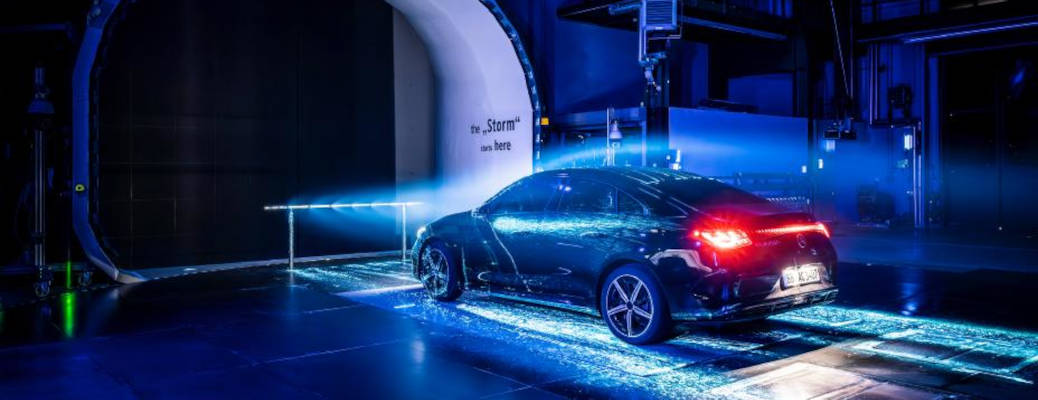
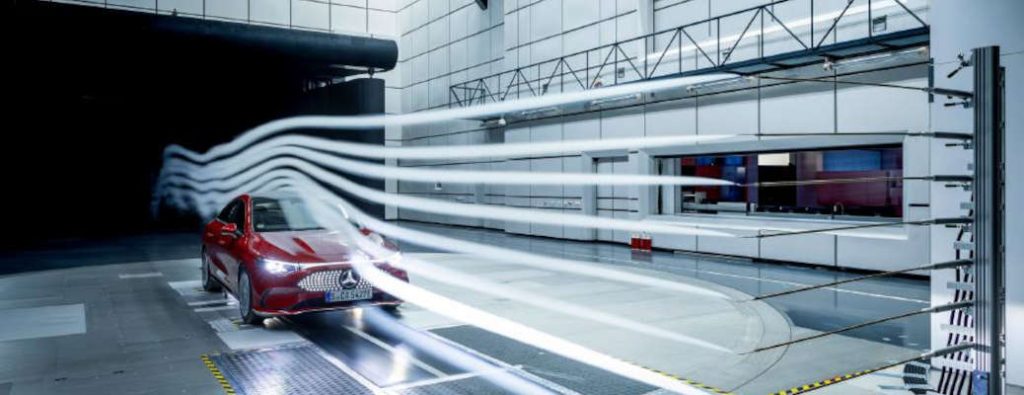
The commitment to maximizing airflow efficiency is evident in Mercedes-Benz’s rigorous development process. While initial airflow optimization was done using physical models, consequently, this crucial work is now carried out with high-performance simulation clusters using Computational Fluid Dynamics (CFD). Significantly, this allows for extensive simulations and rapid optimization long before a prototype hits the wind tunnel. The state-of-the-art aeroacoustic wind tunnel in Sindelfingen—which is still one of the most powerful and quietest of its kind—offers a five-belt system that perfectly replicates road conditions up to 165 mph.
This relentless fine-tuning extends to countless small details:
- Underbody Paneling: The underbody is almost completely closed and suspension components are covered for smooth, unimpeded airflow.
- Wheel Optimizations: Special wheel spoilers and bicolored full covers for alloy wheels are used to reduce air resistance.
- Active Grille Shutters: A louver system behind the radiator grille on many models regulates airflow through the engine compartment based on cooling needs, thus maximizing efficiency.
You Might Also Like: What Is AMG® ACTIVE RIDE CONTROL?
Comfort and Safety Disciplines in Aerodynamics
Beyond pure efficiency, Mercedes-Benz aerodynamics also enhances crucial areas like comfort and safety. Firstly, low-lift values ensure exceptional handling stability. Secondly, the discipline of aeroacoustics is vital for long-distance comfort. Mercedes-Benz specifically investigates the psychoacoustical effects, ensuring a whisper-quiet cabin even at high speeds. Indeed, the human ear can easily localize annoying wind noises, therefore, the brand utilizes an array of nearly 500 microphones and measuring dummies like “Tanja” to pinpoint and eliminate these weak points. Furthermore, to enhance safety, a separate set of contamination tests are performed to ensure side windows and mirrors remain as clean as possible, optimizing visibility under all conditions.
Find World-Class Aerodynamic Engineering at Mercedes-Benz of Scottsdale
We invite you to experience this world-class engineering firsthand at our Mercedes-Benz dealership near Scottsdale. The science of airflow is a core part of what makes owning a three-pointed star so rewarding. Ready to shop for a new Mercedes-Benz? We’re here to help!