2027 Mercedes-Benz GLC MB.OS Explained
Vehicle operating systems have become as consequential to the ownership experience as the powertrain beneath the hood — and Mercedes-Benz’s decision to develop MB.OS as a proprietary, vehicle-native platform rather than adapting third-party software reflects the same engineering philosophy that has driven the brand’s hardware development for decades. What is MB.OS in the 2027 Mercedes-Benz GLC? Understanding it matters before the purchase rather than after, because the operating system’s architecture determines how every digital system in the vehicle functions, communicates, and improves over time in ways that the specification sheet’s feature list doesn’t fully convey. MB.OS unifies infotainment, driver assistance, powertrain management, and connected services under a single software architecture with a common computing foundation — an integration approach that reduces the latency and communication gaps that multi-supplier software stacks in previous vehicle generations produced between systems that were built independently and connected after the fact. Mercedes-Benz of Scottsdale carries the 2027 GLC with MB.OS across available configurations for buyers who want to understand the platform firsthand.
What Is MB.OS?
A Vehicle Operating System Built From the Ground Up
MB.OS — Mercedes-Benz Operating System — is a proprietary software platform developed internally by Mercedes-Benz to replace the multi-supplier software architecture that previous vehicle generations used, where different systems operated on independent code bases that communicated through interfaces rather than sharing a common foundation. Building the operating system internally gives Mercedes-Benz control over update deployment, feature development timelines, and system integration depth that supplier-dependent platforms structurally limit — the same reasoning that led smartphone manufacturers to develop proprietary operating systems rather than assembling devices from independent software components. MB.OS runs on high-performance computing hardware with processing capacity that supports real-time AI applications, sensor fusion for driver assistance systems, and the continuous data processing that over-the-air improvement requires to function as intended rather than as a periodic maintenance convenience.
How Does MB.OS Work in the 2027 Mercedes-Benz GLC?
MB.OS operates as the unified software layer connecting the GLC’s MBUX infotainment, Active Safety systems, powertrain management, and connected services through shared computing resources rather than routing communication between separate control units that each run their own software independently. This architecture means the voice assistant can access vehicle system data — current range, navigation status, climate settings — without the latency that inter-system communication across different software environments introduces in vehicles where these functions operate in separate domains. Driver inputs, sensor readings, navigation data, and connectivity status all feed into the same processing environment, which allows MB.OS to surface contextually relevant information and make cross-system adjustments that previous architectures couldn’t execute with the same speed or coordination.
Do You Need Mercedes-Benz 4MATIC® AWD for Arizona Driving?
What Features Does MB.OS Enable in the 2027 GLC?
Large language model AI for the voice assistant operates on MB.OS’s computing foundation, enabling conversational interaction that processes natural language commands without requiring keyword-pattern matching — the quality of voice control that previous MBUX versions approximated becomes more consistent when the AI has dedicated, high-performance computing resources rather than competing for capacity with other vehicle systems. Predictive navigation that adjusts routing based on battery state in GLC 400 Electric configurations, proactive driver assistance that anticipates road geometry from navigation data, and personalization that builds usage profiles across vehicle systems all benefit from the unified data environment that MB.OS provides. Over-the-air update deployment improves across the full system rather than requiring separate updates for individual modules — Mercedes-Benz can deploy improvements to voice recognition, driver assistance calibration, and energy management through single update packages that the fragmented architectures of previous generations couldn’t deliver equivalently.
How Does MB.OS Improve the GLC Driving Experience?
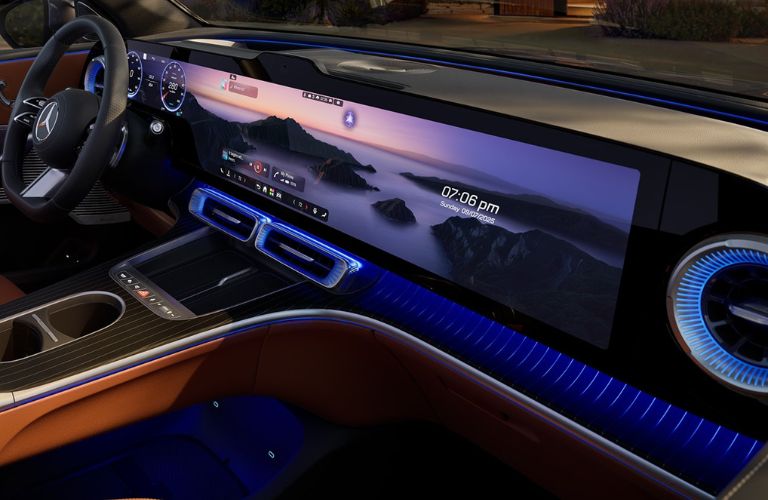
System response speed improves when the software architecture shares computing resources rather than routing requests between independent control units — the practical result is MBUX interface interactions that feel immediate rather than considered, voice assistant responses that arrive before the driver has finished parsing whether the command registered, and driver assistance interventions that execute with the timing precision that shared-platform processing enables. Ambient lighting, climate, seat memory, and audio preferences can respond to driving context in coordinated ways that individually managed systems can’t synchronize — the cabin adapts as a unified environment rather than as independent systems that happen to occupy the same space. For Scottsdale commuters who interact with vehicle technology consistently throughout their drive, the cumulative effect of faster response and better coordination produces a daily experience that feels more cohesive than previous generations delivered, despite similar feature specifications on paper.
Does MB.OS Control Driver Assistance in the 2027 GLC?
Driver assistance systems, including Active Distance Assist DISTRONIC, Active Lane Change Assist, and Active Brake Assist, operate within the MB.OS architecture rather than as standalone systems with independent software, which means they share sensor data, processing resources, and can communicate their status to the driver through the MBUX interface with a consistency that separately managed systems can’t always maintain. Sensor fusion — combining camera, radar, and ultrasonic sensor data to create a unified environmental model — benefits from the common computing platform that MB.OS provides, producing driver assistance behavior that responds to complex real-world scenarios more accurately than systems interpreting the same inputs through separate processing chains. For Arizona driving that involves sudden weather changes, construction zone navigation, and the varied road geometry between Scottsdale’s urban grid and northern routes, driver assistance that operates from integrated sensor data rather than independent system responses produces more predictable behavior in exactly the ambiguous scenarios where that predictability matters most.
Is MB.OS Useful for Electric GLC Owners?
Electric GLC configurations — GLC 400 4MATIC® Electric — benefit from MB.OS’s unified architecture in ways that combustion-powertrain buyers experience less directly. Battery management, charging optimization, range prediction, and energy recovery calibration all operate within MB.OS rather than as separate EV management software, which allows the navigation system’s route data to inform energy management decisions in real time rather than requiring the driver to manually engage economy modes when range conditions warrant conservation. Predictive charging that identifies optimal charging opportunities based on route planning, battery condition, and charging station availability represents exactly the cross-system coordination that MB.OS’s unified architecture enables, and that separately managed EV and navigation systems can’t execute with equivalent sophistication.
The Tech Behind the Tri-Pointed Star: Demystifying MBUX vs MB.OS
Why Does MB.OS Matter When Shopping for a 2027 Mercedes-Benz GLC?
Buyers evaluating the 2027 GLC against competitors should ask specifically about the software architecture rather than only the feature list — two vehicles can offer equivalent feature descriptions while delivering meaningfully different experiences depending on whether those features operate on a unified platform or a collection of independently managed systems. Over-the-air update history and future roadmap matters alongside current capability, because a vehicle whose software improves throughout ownership delivers increasing value, while one that reaches its capability ceiling at delivery depreciates in user experience even without hardware changes. MB.OS’s proprietary development means Mercedes-Benz controls the update cadence and capability additions — a commitment to software development that affects the ownership experience for years after the purchase date.
Learn More About MB.OS in the 2027 Mercedes-Benz GLC at Mercedes-Benz of Scottsdale
Our team at Mercedes-Benz of Scottsdale can demonstrate MB.OS during a test drive that covers the voice assistant, driver assistance integration, and over-the-air update capability in real Scottsdale driving conditions rather than a controlled showroom demonstration. We carry the 2027 GLC across combustion and electric configurations and discuss financing options across all variants.
Understanding what MB.OS is in the 2027 Mercedes-Benz GLC makes most sense through firsthand experience rather than technical explanation. Visit Mercedes-Benz of Scottsdale to evaluate the platform in person, compare available GLC configurations, review financing options that align with your ownership goals, and schedule a test drive that demonstrates what unified vehicle software architecture actually delivers in daily use. Our team is ready — stop by and experience the difference.